ROOTS OF SUCCESS
Pre-Apprenticeship and Apprenticeship Program
Preparing youth and adults for jobs that strengthen communities, support essential infrastructure systems, and create lasting opportunity.
Roots of Success is an empowering federally registered pre-apprenticeship and apprenticeship program that prepares youth and adults facing barriers to employment for living-wage jobs in green infrastructure sectors. The program builds knowledge, skills, credentials, and clear pathways to employment and advancement.
Since 2009, we’ve partnered with more than 500 programs in over 40 states, training over 28,000 people, including more than 13,000 who completed the program while incarcerated. Participants are prepared for meaningful, dignified, living-wage jobs and career pathways.
A study of 1,200 Roots of Success graduates found that 75% secured employment within three months, and 70% were still employed six months later.
CREDENTIALED PATHWAYS
Learning that leads to living-wage jobs and leadership opportunities
Roots of Success connects classroom learning to recognized credentials and real workforce pathways in green infrastructure sectors.
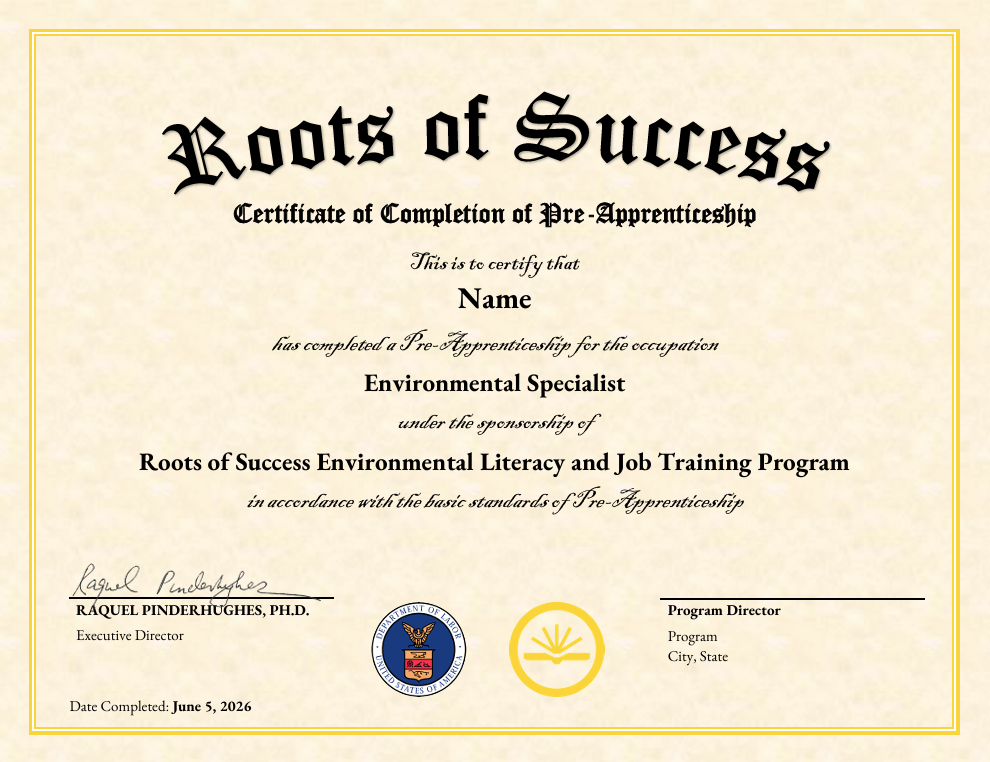
Pre-Apprenticeship
Environmental Specialist Credential
Pre-Apprentices earn an Environmental Specialist credential and build core competencies employers seek in green infrastructure roles, including systems thinking, critical thinking, problem-solving, communication, teamwork, initiative, and professionalism.
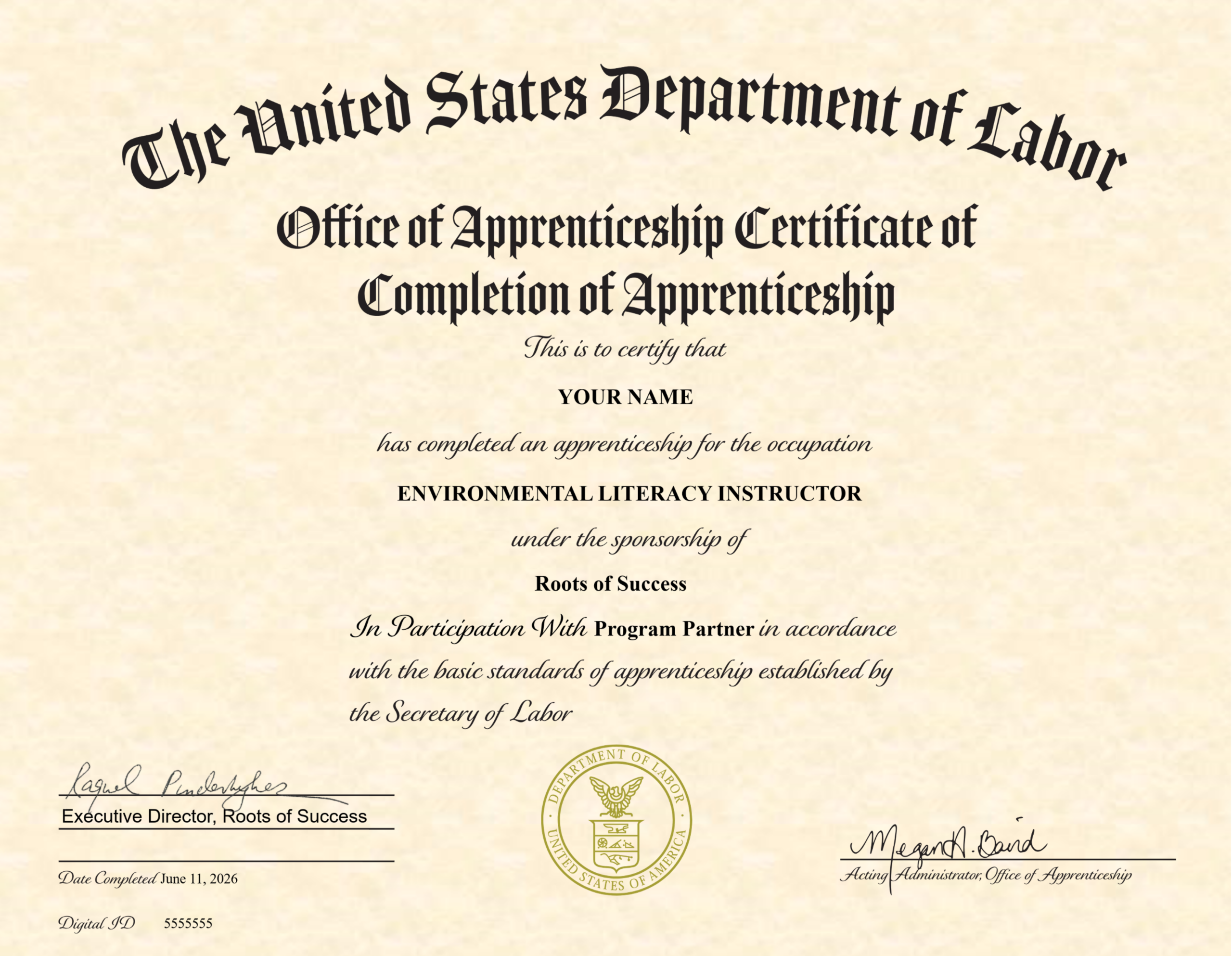
Apprenticeship
Career Technical Educator Credential
Apprentices earn a federally registered Career Technical Educator (CTE) credential as Environmental Literacy Instructors. They develop advanced instructional and leadership skills and the ability to effectively train others for living-wage jobs in green infrastructure sectors.
WHO WE SERVE
Built for people too often left behind
Roots of Success was designed for youth and adults who have been failed by the education system and other systems. Most participants have experienced poverty, incarceration, unemployment, unstable housing, under-resourced schools, and limited access to quality training and living-wage jobs.
In Roots of Success classrooms, participants who have experienced systemic barriers are not treated as the problem to be solved, but as an essential part of the solution.


When I was incarcerated, I did not know if I would ever have a place in society. Teaching the Roots of Success course gave me purpose, responsibility, and a new way to see myself. I went from taking the course, to teaching it, to training other instructors, and ultimately to working in a green infrastructure job when I returned home. That is what Roots of Success does. It helps people who have been seen as having nothing to contribute recognize their value, develop their skills, and build futures they can be part of, and proud of.
THE CLASSROOM EXPERIENCE
Where knowledge becomes confidence, direction, and leadership
A Roots of Success classroom is more than a training space. Participants learn how essential infrastructure systems work, how these systems affect their communities, and how their knowledge and skills can connect them to living-wage jobs and community solutions.
Through discussion, activities, career exploration, and applied learning, participants build analytical thinking, professional vocabulary, problem-solving skills, communication skills, financial literacy, leadership, and confidence.
Over time, participants begin to see themselves as workers, problem-solvers, advocates, and leaders with an important role to play in society.
Knowledge
Participants learn how water, waste, transportation, energy, buildings, food systems, and open space shape daily life and create job opportunities.

Skills
Participants build workplace communication, applied problem-solving, reliability, safety awareness, and career readiness.
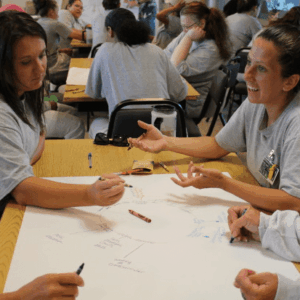
Leadership
Participants learn to use their knowledge and skills to improve conditions in their communities and help others access new opportunities.
HOW ROOTS OF SUCCESS WORKS
A structured pathway from learning to credentials to opportunity
Learn
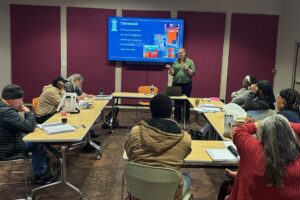
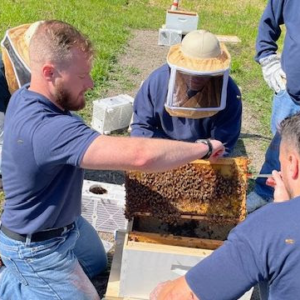
Participants complete a 10-module, multimedia, activity-based course that builds environmental literacy, systems thinking, applied skills, and career readiness.
Earn Credentials
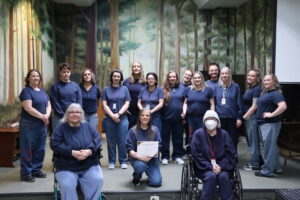
Pre-apprentices earn an Environmental Specialist credential. Apprentices earn a Career Technical Educator (CTE) Environmental Literacy Instructor credential.
Move Forward
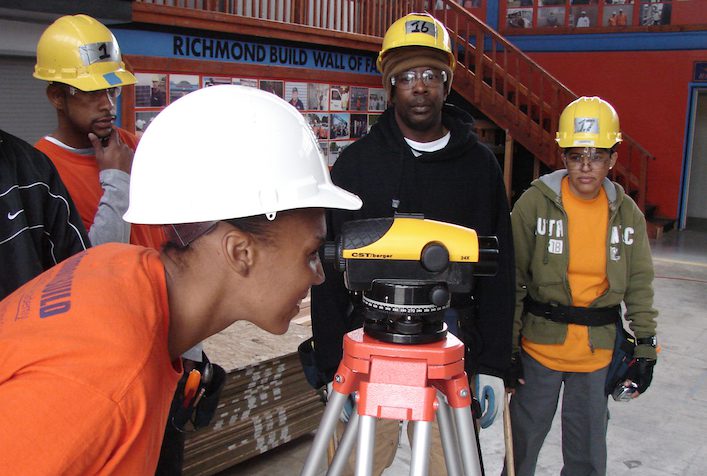
Graduates are prepared for additional training, apprenticeships, leadership roles, and career pathways in green infrastructure sectors.
We prepare people for jobs in essential infrastructure sectors and empower them to contribute to healthier, stronger communities.
Jamie Brewster - Asian Neighborhood Design, San Francisco, CA
Roots of Success Gives Students a Well-Rounded Education
Read the full transcript
Speaker in this video
- Jamie Brewster
00:00:00 It's a beautiful thing to be able to interact with the students and help overcome their barriers.
00:00:18 We have a 14-week training program here.
00:00:20 Fridays are dedicated for life skills.
00:00:22 That could be anything from sexual harassment,
00:00:25 effective communication on the job, anything that they should have taught us in high school but didn't, those are the stuff that we really try to hit them hard with here.
00:00:32 So coupling that with the Roots of Success has just been great.
00:00:38 It just gives them so much more information than we were able to give them on our own.
00:00:42 The most important thing is just the general knowledge that they gain.
00:00:46 One of the things that we're trying to do here overall is to teach our students to where they could be ambassadors of green.
00:00:52 It's nice to give them different aspects of it, looking at it from transportation point of view, from buildings point of view, and then at the end being able to put it all together in the wrap-up module.
00:01:02 When they walk out of the door, they can go into their neighborhoods and the information that they've got here, they can share with their family, their kids, their aunts, their uncles, whoever they live with.
00:01:11 And through small incremental changes, we can do big things.
00:01:14 The highlights are probably knowing that two of my graduates from two separate cycles ended up getting jobs with the Department of Environment.
00:01:21 And I think that a lot of that has to do with the fact that they were able to go in there and speak about so many different facets and aspects of green.
00:01:28 Because we cover everything from transportation to water to energy in the Roots of Success.
00:01:32 So it's just giving them a more well-rounded education, in my opinion.
00:01:38 I know I had one student come up to me this cycle and thank me for the Roots.
00:01:43 Particulate matter was the subject that he brought up.
00:01:47 He's like, yeah, I never knew about that particulate matter stuff.
00:01:50 And I'm just like, yeah, well, now you do.
00:01:52 Go tell somebody.
00:01:54 More opportunities are finally starting to develop for our kids under the green umbrella.
00:01:59 So I can only anticipate more.
00:02:01 That's the hope for the future.
- Environmental literacy
- Critical thinking
- Problem solving
- Decision-making
- Collaboration
- Advocacy/Civic engagement
- Career development
- Financial literacy
- Social entrepreneurship
- Leadership development
- Information literacy
- Public speaking
GREEN INFRASTRUCTURE SECTOR JOBS
Preparing people for the systems and services every community needs
These sectors include the essential systems that keep communities running. Roots of Success prepares participants to understand how these systems work, what jobs exist within them, and how their skills can contribute to healthier, more resilient communities.
Water

- Water Treatment Plant Operator
- Water Quality Technician
- Water Distribution Operator
- Wastewater Treatment Operator
- Drinking Water Inspector Assistant
- Water Meter Reader
- Rain Garden Installer
- Irrigation Technician
- Hydrant Maintenance Worker
- Water Sampling Technician
Waste

- Recycling Coordinator
- Solid Waste Equipment Operator
- Waste Management Technician
- Sanitation Driver / Collector
- Compost Facility Operator
- Zero Waste Technician
- Resource Recovery Worker
- Material Recovery Facility Sorter
- Landfill Equipment Operator
- Food Waste Recovery Worker
Transportation

- Public Transit Worker
- Freight / Cargo Handler
- Transportation Maintenance Technician
- Logistics Technician
- Transit Driver
- Bicycle Mechanic
- Traffic Control Worker
- Mobility Program Assistant
- Road Maintenance Worker
- EV Maintenance Worker
Energy

- HVAC Technician
- Weatherization Technician
- Energy Auditor
- Solar Installer
- Heat Pump Installer
- EV Charging Station Installer
- Smart Meter Installer
- Utility Lineworker
- LED Lighting Installer
- Energy Auditor Assistant
Building

- Building Maintenance Technician
- Green Construction Laborer
- Carpenter
- Concrete Finisher
- Mason/Bricklayer
- Drywall Installer
- Painter
- Roofer
- Sprinkler System Installer
- Building Performance Technician
Food & Open Space

- Horticulturialist
- Nursery Manager
- Environmental Compliance Assistant
- Trail Maintenance Worker
- Landscaper
- Environmental Field Technician
- Urban Forestry Technician
- Grounds Maintenance Worker
- Environmental Remediation Technician
TRANSFORMATION IN ACTION
More than a program; a pathway that changes how people see themselves.
Roots of Success classrooms create space for participants to connect lived experience to real-world systems, jobs, and solutions. Over time, participants begin to lead conversations, support classmates, build confidence, and plan next steps.
Many graduates are hired into living-wage jobs. Some enter the Roots of Success Apprenticeship program and become instructors. Others use what they learn to improve conditions inside facilities, in neighborhoods, and across communities.
Haydee Burrola - Five Keys Charter School, San Bernardino, CA
Roots of Success Inspires and Empowers Students
Read the full transcript
Speaker in this video
- Haydee Burrola: Roots of Success Instructor, Five Keys Charter School
00:00:00 When I heard about Roots of Success, I knew that it was something that I wanted to teach.
00:00:04 It helps students increase their literacy skills, their math skills, but it also gives them this critical consciousness about their place in society.
00:00:13 They're able to earn college credits if they qualify.
00:00:16 And so the opportunities that Roots of Success brings is so much more than just academic.
00:00:22 We had interest in construction.
00:00:24 We had interest in the solar panels.
00:00:27 And in the wind, becoming a wind technician.
00:00:31 There are students who are really interested in that.
00:00:32 I have a few students, a couple of them are enrolled in community college, and one of them is working for the city.
00:00:40 There's another student who I'm really proud of, Yolanda, who had a couple of chickens already, and she decided to increase the number of chickens that she was going to have so that she could have more eggs.
00:00:54 And so that she could share them with her neighbors.
00:00:58 There's actually an activity here where we start a mock business, and everybody was so excited about Yolanda's chickens. She would show us the eggs and everything, that we decided to do it on that.
00:01:09 Like one of the groups did it on that, and so they named it like Yolanda's Chicken Farm, or Yolanda's Organic Eggs, and they created this whole business plan around her chicken farm.
00:01:21 I feel super emotional when I talk about Roots of Success because I've seen what it's done in my students' lives just in terms of empowering them.
00:01:32 They advocate for their children.
00:01:35 They advocate for their community.
00:01:38 Besides employment skills, they've found different ways to advocate for themselves beyond employment.
00:01:45 And so to me, that's really powerful.
WHAT EDUCATORS AND PARTNERS SAY

Roots of Success is particularly well suited for young people who have not been well served by the schools. It is a tool that can help address career and college readiness for young people with low levels of literacy. The curriculum works because it is engaging, adaptable, easy to teach, works well for students with different learning styles, promotes collaboration, problem solving and student leadership.
Roots of Success is helping us educate offenders about the importance of conserving resources in our facility. In the last year, we’ve reduced our trash bill from $95,000 to $5,000. It is also helping us to prepare offenders for reintegration and employment.

Earning college credit helps students move towards college. For students who do not see themselves in college, Roots offers a multitude of growing career pathways that do not require a college degree.
THE CURRICULUM
Ten modules connecting environmental literacy, workforce training, and career pathways
- Fundamentals
- Water
- Waste
- Transportation
- Energy
- Building
- Health, Food & Agriculture
- Community Organizing & Leadership
- Financial Literacy & Social Entrepreneurship
- Application & Practice

The Fundamentals of Environmental Literacy (Introduction) Module helps students think about the interconnectedness between natural systems, biological systems and social systems. It focuses on: the economy, natural and built environments, extraction and use of natural resources, global warming, climate change, bioaccumulation, synergistic effects, how decision makers evaluate environmental issues, cost-benefit analysis, how environmental decisions affect communities differently, climate justice, and how people advocate to improve environmental conditions in their community. Students go through a series of activities that allow them to analyze environmental issues, problems, and solutions from the multi-disciplinary perspectives of environmental science, math, technology, public health, social science, land use planning, policy analysis, environmental justice, and civics. The job readiness exercise focuses on understanding career pathways and ladders.
 The Water Module introduces students to basic concepts and issues relevant to water extraction, management and use, the characteristics of water, how water is used in different settings, the importance of water for humans and other species, the water cycle, water use in agriculture, modern water management approaches, the inequitable distribution of fresh water, groundwater extraction, wastewater management, and water contamination. Activities allow students to analyze approaches to conserving water and reducing contamination, including: water saving technologies, greywater and rainwater catchment systems, native and edible landscaping, ecological wastewater treatment systems, and incentive programs offered by local governments or utilities. The job readiness exercise enables students to identify their professional strengths and weaknesses and develop a plan for improving professional weaknesses. In addition, students identify career pathways and entrepreneurial opportunities in the water sector.
 The Waste Module introduces students to a range of issues related to waste management and resource recovery. Students learn about the waste stream and how it has changed over time, bury and burn strategies, problems that stem from the way institutions and individuals dispose of products and materials at the end of their identified lifecycles, alternative waste management approaches, resource recovery, appropriate technologies, and the 4 Rs. A job readiness exercise focuses on job searching skills and strategies, including identifying and responding to job listings. In addition, students identify career pathways and entrepreneurial opportunities in the waste recovery sector.
 The Transportation Module helps students understand land use planning, the development of transportation systems and infrastructure, diverse transportation modes and transit systems. The module focuses on renewable and nonrenewable resources, the role of fossil fuels in modern transportation systems and vehicles, problems stemming from urban sprawl, greenhouse gas emissions, and air contamination, policies that promote transit-oriented development, alternative fuels, and transportation justice. A job readiness exercise focuses on resume writing. In addition, students identify career pathways and entrepreneurial opportunities in the sustainable transportation sector.
 The Energy Module helps students understand diverse energy sources, the principles of electricity, the role of energy in the world and in our lives, and the economic, political, environmental, and social factors that influence energy decisions. Students are introduced to the characteristics of energy and electricity, basic concepts and issues relevant to energy systems, the role of fossil fuels and nuclear energy in modern electricity systems, greenhouse gasses and their impacts, and problems associated with the burning of fossil fuels. The module focuses approaches and technologies that help people reduce energy use, renewable energy sources and policies that promote clean energy and climate justice. The job readiness exercise helps students write a cover letter to an employer. In addition, students identify career pathways and entrepreneurial opportunities in the clean energy sector.
 The Building Module introduces students to basic land use planning, building, and green building concepts. The focus is on built environments, building design and construction, building materials, building systems, embodied energy, indoor air quality, energy and water consumption in buildings, environmental and public health impacts of conventional building practices, green building principles and practices, improving building efficiency, and resource conservation in the construction, operation, and deconstruction of buildings. The job readiness exercise focuses on preparing for a job interview and mock interviews. In addition, students identify career pathways and entrepreneurial opportunities in the building sector. The module supports students studying for the BPI (Building Performance Institute) exam.
 The Health, Food & Agriculture Module focuses on human health, food systems, and agricultural production. Students learn about health, nutrition, local and global food systems, agricultural practices, industrial agriculture, global food systems, factory farming, GMO crops, processed and fast food, food deserts, how to increase health and food justice, local food systems, urban agriculture, backyard and community gardening, and health education. A final activity has students envision their local food system and think about how new businesses and initiatives could improve health and food access in their communities. The job readiness exercise has identify career pathways and entrepreneurial opportunities in the sustainable food, agriculture, and public health sectors and think about career pathways they may like to pursue.
 The Community Organizing & Leadership Module introduces students to civic engagement, advocacy, community organizing, and leadership approaches, strategies, and skill sets. The module helps students understand the roles and responsibilities of an effective advocate and organizer. Students identify the root causes of problems, build a community-based organization, craft a mission statement, identify organizational goals and values, strategize campaigns, and simulate door-to-door campaigns. The job exercise has students think about career pathways in advocacy and civic engagement.
 The Financial Literacy & Social Entrepreneurship Module focuses on personal financial literacy and on basic business practices, skills sets, and green business principles. Students think about how they can address problems in their communities through entrepreneurial initiatives. In the first part of the module, students’ focus on their personal finances and learn how to analyze income and expenses, create a budget, set financial goals, deal with debt and predatory lenders, establish savings, and effectively manage their finances. In the second part of the module, students develop green business ideas and business plans, and focus on how to operate a small green business, effective communication skills, business models, basic accounting, target markets, hiring staff, financial reporting, and recruiting advisors.

Bring Roots of Success to the people your program serves
Partner with Roots of Success to prepare youth and adults for living-wage jobs, credentials, leadership, and career pathways in green infrastructure sectors.