
OUR IMPACT
We prepare participants for living-wage jobs in essential green infrastructure sectors through applied knowledge and skills-based training
Roots of Success equips youth and adults facing barriers to employment with applied knowledge, skills-based training, and credentials needed to access jobs and career pathways in water, waste, transportation, energy, buildings, food systems, and open space sectors.
Participants in our Pre-Apprenticeship program earn an industry-recognized Environmental Specialist credential. Those who complete our Registered Apprenticeship earn a federally registered Environmental Literacy Instructor Certified Technical Educator (CTE) credential.
Prepared for living-wage jobs
Took the program while incarcerated
Program Partners
Instructors Trained
Our Apprenticeship and Pre-Apprenticeship are offered in English and in Spanish.
WHO WE SERVE
The people and communities at the center of our work
Roots of Success serves youth and adults who have been systematically excluded from stable employment opportunities. Most participants come from communities shaped by poverty, under-resourced schools, unstable employment, and involvement with the justice system.
Participant Demographics
Gender
Race/Ethnicity
Age
Education
Income
Barriers Participants in Our Program Face
%
Low or No Income
%
Unemployed
%
Previously Incarcerated
%
Housing Insecure
Despite facing multiple barriers participants bring dedication, resilience, lived experience, and untapped potential. Our program channels these strengths into workforce knowledge and skills, industry-recognized credentials, and pathways to living-wage jobs in essential infrastructure sectors.
Participants graduate with stronger skills, clearer direction, and a foundation for long-term economic mobility and professional development.
PROGRAM OUTCOMES
We Prepare Participants for Living Wage Jobs in Green Infrastructure Sectors
Programs using Roots of Success for 2+ years found transformative results among 1,200 graduates.
%
Saw improvements in participants academic skills
%
Said Roots of Success familiarized participants with green infrastructure jobs and career pathways
%
Felt participants were better prepared for job interviews
%
Said Roots of Success motivated participants to become civically engaged
%
Said Roots of Success improved students' communication and public speaking skills

Roots of Success helps me engage and prepare low-income youth of color for the 21st century labor market and green economy. The certificate has a significant impact on their ability to find work.

About 70% of the 127 ROS graduates have been offered jobs in the Sustainable Practices Lab, and no one can recall anyone turning down the opportunity. A great model for turning theory into practice.

Women enter these walls with shattered lives and scattered focus. Roots of Success has proven to be instrumental in providing a compass, guiding students as they discover a health and sustainable direction for the future. Women graduate with an eagerness to participate in their own lives. Roots of Success gives beyond, to a place they can reach and and rejoin their community on a pro-social, eco-forward, career pathway.
We provide partners with customized curriculum, professional development, and technical support to deliver high quality training aligned with green infrastructure jobs
Jamie Brewster - Asian Neighborhood Design, San Francisco, CA
Roots of Success Gives Students a Well-Rounded Green Education
Read the full transcript
Speaker in this video
- Jamie Brewster
00:00:00 It's a beautiful thing to be able to interact with the students and help overcome their barriers.
00:00:18 We have a 14-week training program here.
00:00:20 Fridays are dedicated for life skills.
00:00:22 That could be anything from sexual harassment,
00:00:25 effective communication on the job, anything that they should have taught us in high school but didn't, those are the stuff that we really try to hit them hard with here.
00:00:32 So coupling that with the Roots of Success has just been great.
00:00:38 It just gives them so much more information than we were able to give them on our own.
00:00:42 The most important thing is just the general knowledge that they gain.
00:00:46 One of the things that we're trying to do here overall is to teach our students to where they could be ambassadors of green.
00:00:52 It's nice to give them different aspects of it, looking at it from transportation point of view, from buildings point of view, and then at the end being able to put it all together in the wrap-up module.
00:01:02 When they walk out of the door, they can go into their neighborhoods and the information that they've got here, they can share with their family, their kids, their aunts, their uncles, whoever they live with.
00:01:11 And through small incremental changes, we can do big things.
00:01:14 The highlights are probably knowing that two of my graduates from two separate cycles ended up getting jobs with the Department of Environment.
00:01:21 And I think that a lot of that has to do with the fact that they were able to go in there and speak about so many different facets and aspects of green.
00:01:28 Because we cover everything from transportation to water to energy in the Roots of Success.
00:01:32 So it's just giving them a more well-rounded education, in my opinion.
00:01:38 I know I had one student come up to me this cycle and thank me for the Roots.
00:01:43 Particulate matter was the subject that he brought up.
00:01:47 He's like, yeah, I never knew about that particulate matter stuff.
00:01:50 And I'm just like, yeah, well, now you do.
00:01:52 Go tell somebody.
00:01:54 More opportunities are finally starting to develop for our kids under the green umbrella.
00:01:59 So I can only anticipate more.
00:02:01 That's the hope for the future.
Across the country, over 500 program partners have brought Roots of Success into high schools, job training programs, prisons, jails, juvenile facilities, reentry programs, and community settings.
2009 - 2020
2021 - 2026
- High Schools & Youth Programs3%
- Job Training & Reentry Programs33%
- Prisons, Jails, Juvenile Facilities11%
- HBCUs and Other Colleges11%
- Government Agencies5%
- Environmental & Advocacy Organizations27%
- High Schools & Youth Programs17%
- Job Training & Reentry Programs28%
- Prisons, Jails, Juvenile Facilities44%
- HBCUs and Other Colleges3%
- Government Agencies3%
- Environmental & Advocacy Organizations1%
Roots of Success builds environmental literacy and workforce-ready skills aligned with jobs in essential infrastructure sectors
%
More prepared for job interviews
%
Increased professional vocabulary
%
Found employment within 3 months
%
Retained employment 6 months after graduation
%
Improved academic skills
%
More knowledgeable about green careers
%
Have a better understanding of environmental issues
%
More interested in community engagement
We are building a national network of credentialed Career Technical Educators prepared to train people from frontline communities for jobs in green infrastructure sectors
More than 2,000 instructors have been certified to lead Roots of Success classrooms, connecting participants to the knowledge, skills, and career pathways needed in essential green infrastructure sectors
%
Prepared to Teach the Curriculum
%
Instructional Videos Provided Good Orientation
%
Benefited from In-Person Training
%
Prepared to Use Teaching Materials from Training
%
High Quality Teaching Materials
%
Curriculum is Easy to Teach
%
Training Increased Professional Skills
%
Excited to Teach the Curriculum
%
Would Recommend Roots of Success to Similar Programs
%
Curriculum Strengthens Training Program
We help teachers prepare youth for internships, employment, and post secondary education
Robert Tarido - Co-op Technical High School, New York, NY
Read the full transcript
Speaker in this video
- Robert Tarido
00:00:00 Roots of Success changes their entire life, and that's the key.
00:00:04 And that's why I see it such an integral part of what we're doing.
00:00:17 It's deliverable.
00:00:18 It gives you the opportunity to deliver it to the demographic and the kind of students you're working with.
00:00:25 It's not just all kids with one reading level.
00:00:27 The math and also math skills range in the same way.
00:00:30 So you have to have a curriculum that's flexible enough that can reach the kids that have the third grade reading level and keep the kids interested that have a 12th grade reading level.
00:00:41 It uses so many different types of techniques in teaching.
00:00:45 We're using video, okay?
00:00:48 We're breaking into groups, so we're doing group activities.
00:00:51 We're using vocabulary, okay?
00:00:53 And then we're also then asking insightful questions about their communities.
00:00:58 It gives them that aha moment, okay, when they see someone on the screen that's them, and then they read this idea, and then they get the vocabulary.
00:01:08 They hear the word climate change all the time, but then when we talk about what climate change is, and we break it down to them the way the book is, then they know what climate change is.
00:01:17 Then they're like, I know exactly what that is.
00:01:20 It's not dry. It really impacts them on every level.
00:01:25 A lot of times we get curriculum sent down from the state and every teacher has to spend the time to deliver it to their community.
00:01:32 This is already written in a way where it's ready to be delivered to our communities.
00:01:37 It's ready to be delivered to our children.
00:01:40 It connects to them because the environment on another level doesn't connect to them.
00:01:44 And then once they understand that connection, then they understand the job aspect of it, the community, it just all goes like that.
00:01:50 This curriculum identifies right to them.
00:01:52 It gets right to who they are.
00:01:55 I'm hooked on it as much as they are.
00:01:57 And when I taught the first module, I had kids stopping me in the hallway, coming to me and saying, when are you going to teach the electrical module?
00:02:05 When are we going to do the water module?
00:02:08 Getting more kids jobs this way.
00:02:12 I'm proud to say my class, almost all of my students last year got internships, okay?
00:02:18 Because not only did I teach them how to physically do it, with Roots of Success, I was able to give them the skill and the feeling that they could go out there and do that.
We prepare youth to become the next generation of environmental justice activists.
Oscar Medina - High School Teacher and Community Organizer, South Tucson, AZ
Read the full transcript
00:00:00 My name is Oscar Medina.
00:00:01 I'm a high school teacher in southern Arizona, and I am also a community organizer in the city of South Tucson.
00:00:09 The way we're using the Roots of Success curriculum in the high school is we're working directly with at-risk youth, youth that have been traditionally disenfranchised from the educational system.
00:00:24 That have not seen the value in schooling.
00:00:27 And so we use the curriculum to be able to pull them in, to be able to bring their experiences into the classroom and be able to talk about them with a language focus around their environment, focus around their community.
00:00:42 If there wasn't Roots of Success, we would be teaching this out of an environmental science class, we'd be teaching it out of a physics class, we'd be teaching it through a biology class.
00:00:53 And those are disciplines that have not looked at the consequences of the decisions that have been made that impact low-income communities of color.
00:01:04 When I teach Roots of Success, I see some of my students and they're eager to get up and do something.
00:01:13 They're eager to take action because they know that what they're learning is impacting them directly and it's happening now.
00:01:20 It's also provided us with a significant amount of opportunities to do work outside of the classroom.
00:01:28 For example, the food, agriculture and nutrition module.
00:01:32 After going through that module, now we're going to go build a raised bed.
00:01:37 Now we're going to go build a garden.
00:01:40 Now we're going to go compost around the school and we're going to focus on our health and our nutrition and we're going to have better food options.
00:01:48 The certification at the end of the program just creates more of an incentive.
00:01:54 People want to be rewarded for sitting in a class and for engaging and for learning something.
OUR IMPACT IN CARCERAL FACILITIES
Expanding access to training and credentials for incarcerated individuals in prisons, jails, and juvenile detention centers that prepare them for employment after release
In prisons, our Pre-Apprenticeship course is taught by trained and certified incarcerated men and women serving long and life sentences, providing them with professional development, leadership experience, and meaningful opportunities to contribute to the growth and success of others.
- Customized for carceral settings
- Strengthens foundational academic skills
- Promotes positive behavior, confidence, and leadership development
- Prepares individuals for full-time employment upon release
- Reduces conflict and violence inside facilities
- Strengthens financial literacy
- Reduces water, waste and energy costs in facilities

Engaging inmates in meaningful activities and giving them opportunities to contribute reduces violence and makes prisons safer for both inmates and staff.
Many students have expressed that they are grateful that a class like Roots of Success is offered while incarcerated and how the program will benefit them as they reenter their communities.
COST & CARBON SAVINGS IN FACILITIES*
Reduction in annual trash bills across multiple facilities
%
Decrease in electrical usage over 3 years in 9 facilities
Reduction in food waste per week in facilities
*Statistics collected from Ohio DRC; figures are averages
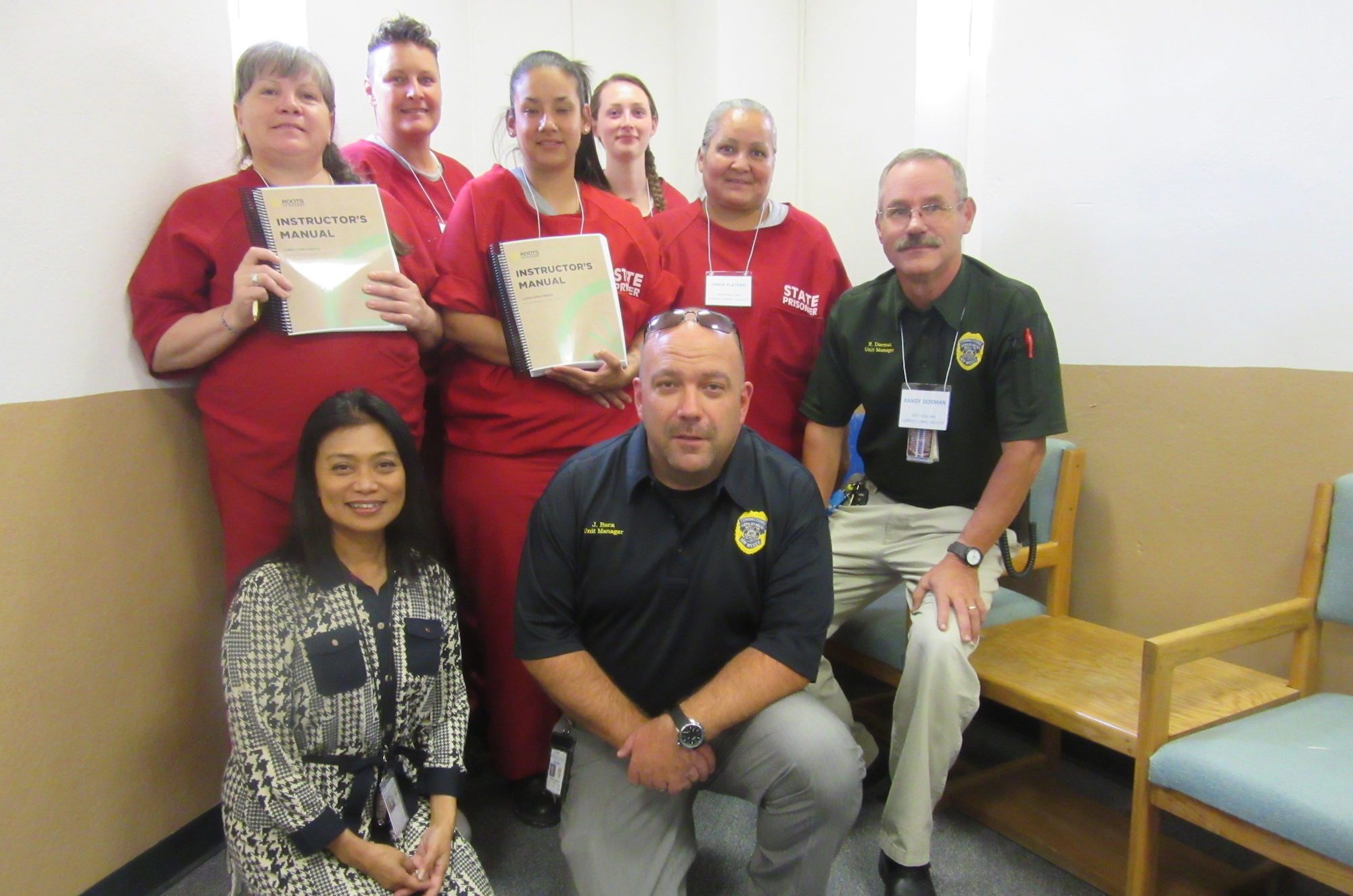
We empower incarcerated individuals and provide them with the knowledge and skills needed to reduce recidivism
Tony Simmons - Southeastern Correctional Facility, Lancaster, OH
Read the full transcript
00:00:00 My name is Tony Simmons.
00:00:02 I'm an inmate at the Southeast Green Correctional Facility here in Lancaster, Ohio, and I've been incarcerated for close to 30 years.
00:00:13 I'm a lifer.
00:00:15 I'm not parole planning right now.
00:00:18 I'm in a situation where I'm getting ready to go over another hurdle of another decade.
00:00:26 I heard the word roots, I thought of growing trees.
00:00:30 I thought of things growing out of the beginning of roots.
00:00:33 And Roots of Success is about growing in the environment.
00:00:37 Is it about growing in the environment of the world?
00:00:40 Well, not in my case.
00:00:41 In my case, it's about growing in the environment of prison and giving them another direction that they can go in and creating a solid foundation based upon the principles and the modules.
00:00:55 Dr. Raquel Pinderhughes has given me the opportunity to have the privilege of being a master trainer, and this to me, I guess a light came on.
00:01:07 The heavens opened up and it really gave me a new purpose in prison.
00:01:11 I'm an educated person, and so because of that I was able to use that to the advantage of not just myself but the department because I have been teaching Roots of Success for over a year now.
00:01:23 I've had the opportunity to have a class that I facilitate, and I've had to share in graduating over 200 students.
00:01:34 The green program and the sustainability package that has been put together by the Department of Corrections in the state of Ohio has proven to be a great tool that's going to decrease recidivism in the state of Ohio and crime because it's providing an opportunity to give people jobs in the green economy.
00:01:55 It sustains them in having a purpose and understanding what's going on with the earth and how they can improve not only themselves but the earth.
00:02:03 They improve their family,
00:02:04 improve their hope for the future because education is all wrapped around this.
00:02:09 It's given me the opportunity to foster other reentry opportunities in the garden that they're growing, the beekeeping and the responsibility that people have in greenhouses, recycling, and the things that's going on in this institution as far as waste management.
00:02:27 It's just so many things that gives me goosebumps really because I'm a part of the education of those individuals.
00:02:34 Roots of Success program, where this is being expanded throughout the state, and I'm excited about being a part of that and I'm excited about seeing where reentry is going to grow.
00:02:47 And where the new environment that we've grown in prison is going to go from the old way they were doing things in prison to the new way of sustaining the kind of environment that fosters a future for ex-offenders that will never have them coming back to jail again.
00:03:05 What else can I say?
00:03:05 It was a success. It works.
00:03:08 It's good.
00:03:09 Thank you, Raquel.
00:03:11 Thank you, Raquel.
We engage individuals serving long and life sentences as peer instructors, applying their skills and supporting the learning of others.
Willie Lagway - Southeastern Correctional Institution, Lancaster, OH
Read the full transcript
00:00:01 Hi, my name is Willie Lagway and I'm incarcerated here at Southeastern Correctional Institution.
00:00:07 I've been incarcerated for a couple of months shy of 30 years.
00:00:12 Roots of Success was coupled with ODRC's sustainability project that they got going.
00:00:18 So we were able to appreciate what DRC was doing, because now we can show these individuals that the knowledge they had could be implemented.
00:00:30 We got to waste managers.
00:00:33 We have many people in the IPPs that come over here who does it,
00:00:39 and they were able to enrich us about the intricacies about waste and telling us how the warden was saving all kind of money because of what they were doing.
00:00:46 And then there's these gardens.
00:00:48 We could take our students out and let them actually look at a garden and see how a garden was made.
00:00:53 And you know, it just was so enriching to where I see myself as a respected person.
00:00:59 But when you have inmates come up to you and call you teacher, you know, in prison, another inmate, I mean, it just moves you.
00:01:07 And you look in their eyes and they're serious, they're not just playing on you, and so now that makes you drive to want to teach more.
00:01:16 And now you start going out getting additional knowledge. It's like a paradox to me,
00:01:24 whereas in prison, you know, you can do something like this.
00:01:32 And these guys are going to the streets, you know, and they're taking their books with them.
00:01:37 And if anybody know how it feels to have your esteem lifted in your spirit, that's how I feel.
00:01:44 That's how I feel as a result of doing this.
00:01:47 I agree with central office. I agree with the director. I agree with my warden, what they're doing.
00:01:53 It's pushing something positive.
IN THEIR OWN WORDS
Stories from Instructors, Participants, and Community Partners
Read the full transcript for Jameelah Muhammad
Speaker in this video
- Jameelah Muhammad
00:00:00
Immediately, from the very first time that I taught Roots, I felt that it connected with the students in a way that was really powerful.
00:00:06
It was really easy for them to understand the concepts.
00:00:10
The flow was very, very intuitive, and being able to start from a very basic level and understanding a very broad set of topics and issues and then really narrowing down on the specific fields and industries that could exist in the green economy.
00:00:23
So I felt like it was, I'd seen a lot of different curriculums, and I felt like it was definitely one of the most comprehensive ones that I have seen.
00:00:30
Roots of Success gives students the skills that they need in order to continue to fight and advocate for green jobs everywhere.
00:00:38
And it also, at the same time, gives them the specific skills that they will need for whatever green career that they're actually trying to pursue.
00:00:45
In terms of the students, they loved it.
00:00:47
They felt like the activities were really engaging.
00:00:50
They felt like a lot of the topics that were being discussed were things that were relevant to their personal lives in terms of experiences that they've had growing up in a community that's maybe been exposed to pollution or has had some sort of economic exploitation.
00:01:03
So it was really incredible to see them take something that was on paper and be able to relate it to their lives in a way where they felt like they had a tool and they had a set of knowledge that would allow them to go out and really become an active agent for change in the green economy.
Read the full transcript for Taleigh Smith
Speaker in this video
- Taleigh Smith
00:00:00
Roots has helped to give our students confidence that they can come into an interview and sound like they know what they're talking about.
00:00:10
It also gives students the context to understand why a job that may not seem green could be green.
00:00:17
The fact that it's being used not just by us, but by a couple different organizations in our neighborhood, means that as we get involved in community projects, a lot of times we'll find these learning moments where someone will say, oh, that's perceived obsolescence or that's bioaccumulation.
00:00:34
And there's this shared vocabulary that's being built among the next generation and the folks that are engaged with the Roots curriculum that's really useful to be able to understand what's happening around us.
00:00:44
We have actually formed a worker-owned cooperative in terms of promoting green roofs and solar panels and educating tenants in terms of accessible ways they can green their lifestyle, like composting and non-toxic cleaning products.
00:01:01
And I'm super excited about that because, like I said, it's been tough to actually get the students employed.
00:01:08
And so the fact that they had the confidence to be an entrepreneur and really take these concepts and address a gap that they see in their community is super exciting, and it's taken it to a new level for me too, moving it from theory into practice.
00:01:22
It's like, okay, we've said that this is what our community needs and what our green economy needs. Now let's build it.
Read the full transcript for Asian Neighborhood Design
Speakers in this video
- Jamie Brewster: Roots of Success Instructor
- Brian: Graduate
- Shaka: Graduate
- Steve Suzuki: AND Executive Director
- Nelson: Graduate
- Amanda: Graduate
- Students: Unidentified student voices
00:00:03
Music:
Music. First class passengers.
00:00:21
Jamie Brewster:
The Roots of Success curriculum involved with this. Just make sure that our students are going to walk out of here as ambassadors of green.
00:00:27
Jamie Brewster:
And that's pretty much the most important thing to me, is that they understand that they can actually make a difference in their community by doing small, incremental things on a daily basis.
00:00:34
Brian:
It's a great curriculum.
00:00:35
Brian:
I'm learning a lot, learning a lot of detailed information about the green economy, green movement, and ways that I'm affected physically and health-wise through pollution and things like that.
00:00:53
Brian:
So it helps me make more informed decisions for the things I put in my body and the things I put into the environment.
00:01:00
Shaka:
It's changing my mind on certain kind of products that I normally buy and how I live when it comes to how serious I need to take it when it comes to recycling and certain kind of products that are being purchased, you know what I'm saying, that really are unneeded.
00:01:16
Jamie Brewster:
To be in the classroom and have an opportunity to interact with them in a group setting has just been priceless.
00:01:30
Student:
Second to being in the Recology Center, a little bit on the learning center, teaching kids and everyone in the community about recycling and the importance of it.
00:01:42
Jamie Brewster:
I think the team building exercises are always good. They build community, they build family.
00:01:49
Jamie Brewster:
The opportunity to work together, give presentations, it increases their self-esteem, it increases their public speaking skills.
00:01:55
Students talking in a small group:
We're going to look at the pros and cons of this. Metal you have to buy for it, right?
00:02:00
Student speaking in a classroom:
He is. [inaudible]
00:02:01
Jamie Brewster:
I try to buy things that don't act as packages, because I'm sure there's usually an alternative that has less packaging than boxes and cereals and bags.
00:02:09
Steve Suzuki:
Roots helps us to tie it all together. So we are talking about the recycling and the construction and all that, but why is critical.
00:02:18
Steve Suzuki:
So when the folks do graduate out of here, our goal is that they pick up the habits, but also talk to your family, teach your children that, so that it actually will make a change.
00:02:29
Steve Suzuki:
Because there's going to be more and more dialogue on this.
00:02:31
Nelson:
I got a little son and hopefully when he gets older he'll get to know more about this, or it's going to be more green collar jobs or stuff like that.
00:02:40
Nelson:
If not, I'll pass it on to him so he can know what's going on and he can be using the same things we're doing right now. Hopefully he'll be aware of everything.
00:02:49
Amanda:
And like I'm glad that I learned what I learned because now I can go home and tell my family.
00:02:53
Shaka:
I stay, you know what I'm saying, in touch with my family on the things that I learned here, which I know that information I can spread out, you know, to my community and family and friends and stuff like that.
00:03:04
Shaka:
But hopefully it'll catch their attention and they can make a change as well.
SUCCESS STORIES
From program graduates to leaders in essential systems that power communities
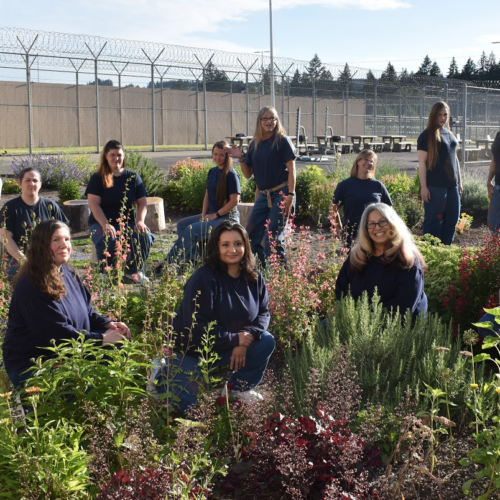
Shelby
As a child, Shelby recalls having traveled to her father’s workplace at an Injection Molding Sector; an experience she brought to her Roots of Success classroom as firsthand knowledge in the plastics industry. Having also spent time learning the trade of a Logging Watchman, she found certification in Roots of Success to help reinforce those values in Forest Stewardship. With knowledge and hard work in various jobs around Coffee Creek Correctional Facility, she’s acquiring the skills needed to gain a productive future with a solid foundation. Shelby’s drive is enabling her to complete the 2,000 hour custodial Technician Certification by helping the hazmat team and buffing floors with the floor crew on top of attending to
Read More About Shelby Here
her studies. With high test scores and perfect attendance in the environmental literacy program, Shelby is looking forward to obtaining her LEED certification along with OSHA and hazmat credentials.
Shelby is gleaning all she can before paroling. Thanks to Roots of Success at CCCF, she will leave with a blueprint for sustainable living, a sustainable future, economical independence, and a newfound social responsibility.
This story is from Coffee Creek Sustainability News June – July 2021 Issue #53 and Shelby was interviewed by Roots of Success Peer Educator Lori Moseley.
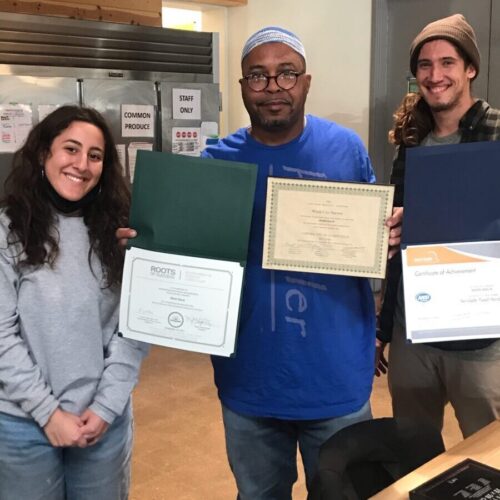
Mark
Mark Mack served 10 years behind bars in the state of Ohio, and came to the Roots of Success program in 2015. “I always wanted to do something educational,” Mark said about why he chose to take the class. “My favorite part was learning about renewable energy, because of global warming and greenhouse gases.”
Upon release, Mark went to Chicago, where Roots of Success staff introduced him to Windy City Harvest at the Chicago Botanic Garden. “It was awesome,” Mark says about the urban agriculture program. “I wish I could get a lot of young brothers and sisters off the street and into a
Read More About Mark Here
program like that. It was very helpful, educational, and humbling, especially the people that get you through the program.” In addition to his urban agriculture training Mark also obtained his forklift, OSHA, and SafeServ certifications while at WCH.
“I thought a lot about the environmental topics that I learned from Roots of Success while at Windy City. Coming back to a big city, I had a deeper knowledge than the others in the program from having taken all the Roots of Success modules.”
What’s next for Mark? “I’m considering going back to school to get a degree. When the time comes, I will. I’m coming out of my shell after being incarcerated, developing my communication skills. I’m applying to work as a custodian at the research laboratory. I want the Roots of Success community to see this is very inspiring to me. Roots of Success has put me on a path to success.”
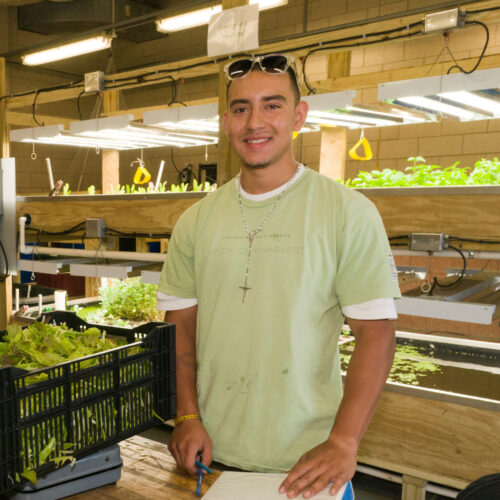
Aaron
Urban Farmer
Roots of Success graduate Aaron Serrano is applying what he learned in the course at his job in the sustainable agriculture industry. Aaron made the most of his time at the Cook County DOC Sheriff’s Boot Camp by participating in a farming program at the boot camp’s three-quarter-acre farm, run by the Chicago Botanic Garden; and then joining the Botanic Garden’s transitional job crew after he was released. From there, Aaron entered Chicago Botanic Garden’s nine-month Windy City Harvest program — an in-depth training in sustainable horticulture and urban agriculture.
Read More About Aaron Here
Roots of Success is offered as part of the training to help participants develop their understanding of environmental issues, the green economy, and social justice.
Soon after graduating from Windy City Harvest and receiving his Roots of Success certificate, Aaron was hired by FarmedHere, LLC — a commercial vertical farm in Mid-West Chicago that grows salad greens, culinary herbs and Tilapia fish. Aaron found Roots of Success to be fascinating, educational, and entertaining — it gave him “a feeling of accomplishment,” while preparing him to apply for, get, and perform the job he has now. In this photo, you can see Aaron working in front of the aquaponic system that FarmedHere uses to grow its ‘Chicago Sweet Basil’ and ‘Windy City Arugula’ year round, organically, and with 97% less water than conventional farming.

Tina
Project Assistant
Tina Addi grew up in San Francisco’s Bay View Hunters Point. Between the ages of 13-22 she spent much of her time in and out of juvenile halls and county prison. In 2009, when she was sentenced to 5 year in federal prison, Tina decided it was time for a change, especially with 2 daughters to care for. Upon her release she was referred to a 15-week job training program where she took Roots of Success. Her newfound knowledge of environmental problems and solutions helped her secure a 2 year position at the SF Environment Now program where Roots of Success is being used as a foundational tool for environmental literacy and professional
Read More About Tina Here
development.
Now as a Project Assistant at Cascadia Consulting, Tina helps local businesses set up their recycling and waste systems and looks forward to a promising future in the waste management field.
“Roots gave me my passions and it drew me to environmental work. Otherwise, I probably wouldn’t care or even really know about environmental issues. Roots of Success made it relatable. It feels like it was written for underserved communities, and I don’t feel like I’m being discriminated against for that reason. ”

Nathan
Adult Education Coordinator
Nathan Hazen Durán grew up in Arizona in the foster care system. He became involved with gangs and was incarcerated at a young age, spending two years in juvenile hall by the age of 15. Upon release, he decided he didn’t want to feel stuck anymore, and earned a scholarship to study Architecture at the University of San Francisco. Three years into college though, his cousin passed away due to gang violence, and Nathan’s grades dropped. Soon after, he got involved with gangs again, and was incarcerated again. This time Nathan was released, he went to Larkin St. Youth Services, where he chose to participate in a job training program
Read More About Nathan
called Asian Neighborhood Design. It was there he took the Roots of Success course.
Roots of Success’ in-depth approach, says Nathan, taught him foundational skills, and helped guide and structure his understanding of environmental issues and community organizing. This helped with job interviews. He says that a lot of city agencies and nonprofits value the Roots of Success curriculum, and that the certificate upon completion of the course helped him on a resume. But even more significantly, it teaches essential environmental and public health issues in the community, and how to approach talking about them.
“Roots was there every step of the way. At every program I entered, they had either used Roots or were currently using Roots.”
Nathan got a job in construction, where he convinced demolition crews to recycle used wood, earning a profit in the process. Using his skills from the ROS financial literacy module, he saved the contractor money and made money himself while applying the education he gained through Roots of Success.
On his lunch break, Nathan started volunteering to teach environmental classes at the Community Housing Project, where he was soon hired. As a Roots teacher and Adult Education program coordinator, he appreciates being able to mentor young adults much like him— many had very few skills, just like when he entered the program. Nathan says he wants to make an impact, especially in those populations that he identifies with. His dream is to serve the population he came from by starting a nonprofit with a community garden and horticulture program where he can teach Roots of Success classes.
“Everyone is very grateful that went through that program,” Nathan says. “People have a lot of respect for Raquel and what she has created. It gave me inspiration and guidance and the know-how to navigate through what I wanted my overall outcome to be.”
To share your story or learn more about how you can support Roots of Success, email us at info@rootsofsuccess.org
Deliver workforce training that leads to credentials, employment, and career advancement.
Roots of Success equips organizations with customized curriculum, instructor training, and implementation support to deliver applied learning aligned with essential infrastructure systems, including water, waste, energy, transportation, buildings, food systems, and open space. Participants build environmental literacy, systems knowledge, workforce skills, and career awareness that prepare them for employment and advancement in these critical sectors.
Partner with us to prepare people for good jobs and to improve conditions in communities
Contact Us
Interested in scheduling a training, reviewing the curriculum, or learning more about how Roots of Success could make an impact in your program? Reach out to us via email below.